
Almost exactly a year ago, I measured how many of the top one million
websites had adopted llms.txt, the web experience optimized for LLMs.
Back then, the number was 1.22 %, or around 12k domains.
A lot has happened in AI since then. Has adoption caught up?
Same measurement, one year later
I reused the exact same crawler implementation and the exact same classification rules as in 2025, applied to a fresh
snapshot of the top one million domains taken on August 20, 2026.
As a reminder, a response only counts
as a valid /llms.txt if it satisfies all of the following conditions:
- HTTP response code must be less than 400
- Content-Type header must start with
text/plain - The web server must accept the connection within 3 seconds
- The response must arrive within 10 seconds
- The site must support HTTPS
- The response content must be longer than 500 chars
- There must be more left square brackets than left angle brackets
See last year’s post why I ended up with these criteria.
Keeping the methodology fixed means the two runs are directly comparable, and any difference in the numbers reflects actual adoption rather than a change in how adoption is measured.
The measurement takes the same top 1 million domain list as last year, neglecting any changes in the popularity of the domains themselves.
Results
Adoption almost tripled. Among the top one million domains, around 35k now serve a valid /llms.txt.
Overall adoption rate therefore is 3.53 %, up from 1.22 % last year.
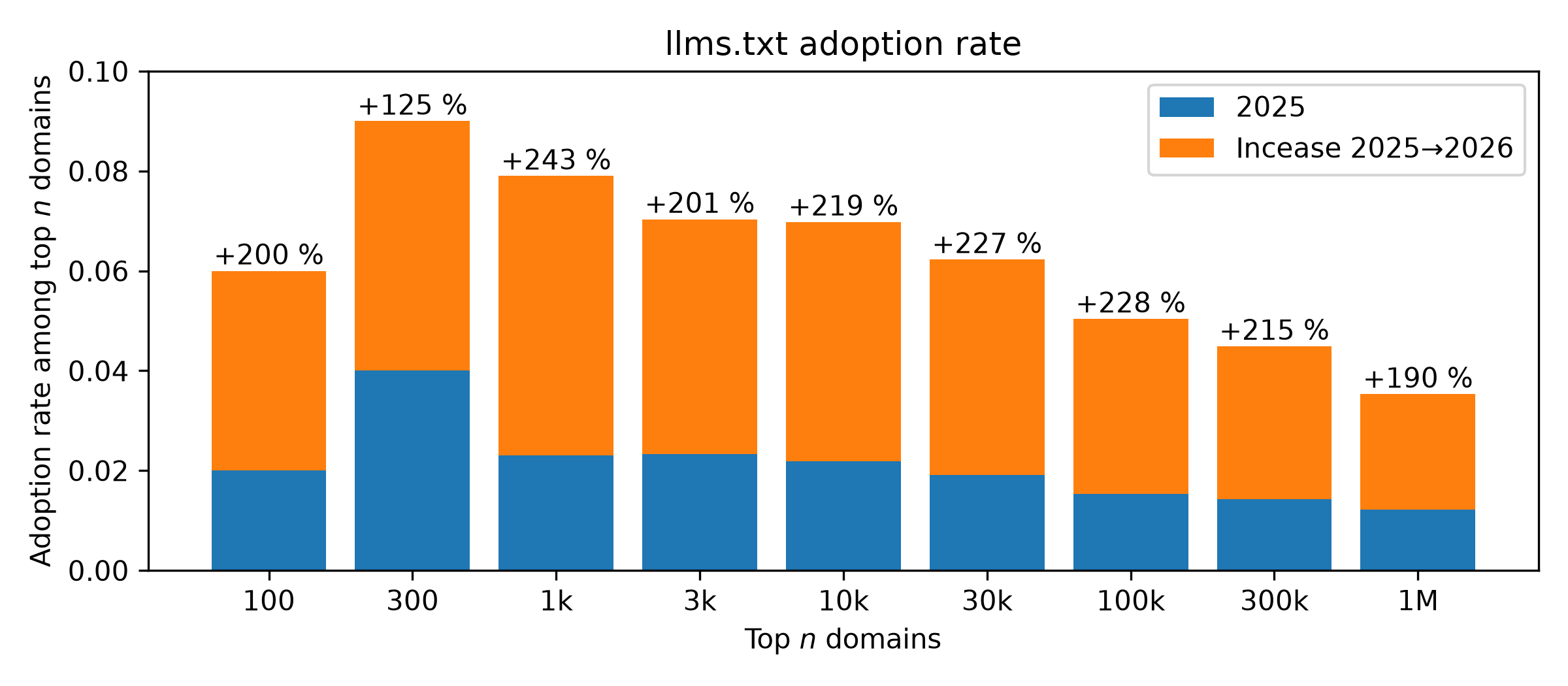
The growth shows up at every popularity rank I looked at, from the top 100 domains to the full top million, with relative increases mostly in the 190-245 % range. The one exception is the top 300 domains, where growth was “only” 125 % — but that’s because the starting point there was already the highest in the dataset. The top 300 domains remain the best-adopting bracket by far, going from 4 % to 9 % adoption.
So while /llms.txt is still a minority practice even among the most prominent domains on the web, over
90 % still don’t serve one) the trend line is unambiguous. Whatever skepticism greeted the proposal a year
ago, adoption is accelerating, not stalling.
The crawler, the analysis code, and the result dataset are available in the same Git repository as last year.
This might also interest you